The Short Answer
Trenchless sewer replacement repairs or replaces a sewer line through one or two small access pits, by relining the old pipe or pulling a new pipe through its path. Open-trench replacement digs along the whole line and lays new pipe. Trenchless causes far less disruption and is often faster; open trench is needed when the pipe has collapsed, sags badly, has the wrong slope or must be rerouted.
Trenchless vs Open Trench at a Glance
| Attribute | Trenchless (lining or bursting) | Open-trench replacement |
|---|---|---|
| Digging | One or two small access points | A trench along the whole line |
| Disruption | Minimal to lawns, driveways and landscaping | Surfaces above the line are dug up and restored |
| Typical duration | Often one day | Often several days |
| Fixes sags and wrong slope | No | Yes |
| Handles a collapsed pipe | Only with a small dig at the collapse | Yes |
| Can change the route | No | Yes |
| Restoration cost | Low | Can be high under concrete or landscaping |
| New pipe | Seamless liner or fused HDPE pipe | New PVC or other approved pipe |
How Does Trenchless Sewer Replacement Work?
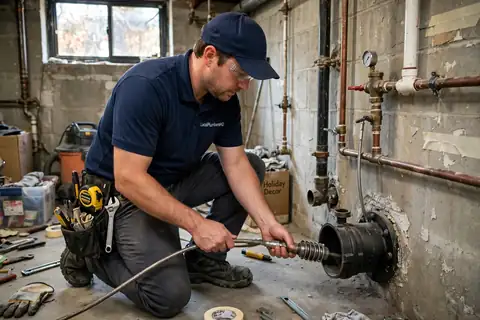
Trenchless replacement uses one of two methods. Pipe lining, also called cured-in-place pipe, inserts a resin-soaked liner into the cleaned old pipe and cures it hard, forming a new pipe inside the old one. Pipe bursting pulls a new pipe through the old line while a bursting head breaks the old pipe outward. Both are covered in detail on our trenchless sewer repair page.
How Does Open-Trench Replacement Work?
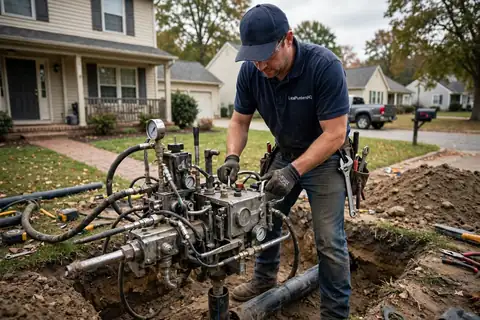
Open-trench replacement digs a trench from the house to the city connection or septic tank, removes the old pipe, lays new pipe on a properly graded bed, and backfills the trench after inspection. It is the traditional method and can fix any problem, including the slope and route of the line. The diagnosis and repair options are explained on our sewer line repair page.
Which Is Faster?
Trenchless is usually faster. Many residential trenchless jobs are completed in a day once the line is cleaned and measured. Open-trench work often takes several days, depending on the length and depth of the line, what sits above it, permits and inspection. Both may wait on permits and inspection before and after the work.
Which Costs Less?
Neither is always cheaper. Trenchless pipe work can cost as much as, or more than, the pipe work in a trench. The saving comes from what is not dug up and replaced: driveways, patios, walkways, mature trees and lawns. When the line runs under open lawn, open trench can be competitive; when it runs under concrete or valuable landscaping, trenchless often costs less overall. Ask for quotes on both when both are possible.
When Is Open Trench the Only Option?
Open trench, or at least a partial dig, is needed when trenchless methods cannot fix the problem.
- A collapsed section blocks the path for a liner or bursting cable.
- A severe sag or belly would remain, because a liner follows the existing pipe.
- The wrong slope cannot be corrected without relaying the pipe.
- The line needs a new route, for example around a new addition.
- Many tight bends make lining or bursting impractical.
A camera inspection shows which of these apply before you choose.
Which Lasts Longer?
Both create a long-lasting sewer line when installed correctly. A cured liner and fused HDPE pipe are jointless or nearly jointless, which resists the root intrusion that ruins old clay pipe. New PVC laid in a trench is also durable and has properly sealed joints. Lifespan depends more on installation quality and ground conditions than on the method.
Which Should You Choose?
Choose trenchless if the pipe still holds its shape, the damage is cracks, roots or leaking joints, and the line runs under hardscape or landscaping you want to keep.
Choose open trench if the pipe has collapsed, sags badly, has the wrong slope, needs a new route, or runs under open ground where digging is simple.
Many repairs combine both: a small dig at a collapsed section, with lining or bursting for the rest of the line.
Related Problems
A sewer smell or slow drains throughout the house are often the first signs of a damaged line; see why a house smells like sewer. Leaks under a concrete slab are a different problem with their own signs, covered in signs of a slab leak.
Trenchless vs Open Trench FAQs
Is trenchless sewer repair permanent?
A properly installed liner or burst-in pipe is designed to last for decades. It is a long-term replacement, not a temporary patch.
Can every sewer line be done trenchless?
No. Collapsed pipe, severe sags, wrong slopes and lines that need rerouting usually need open trench or a partial dig.
Does trenchless work need a permit?
Most sewer replacement work needs a permit and inspection whichever method is used. Your contractor normally arranges both.
Will I lose water or sewer service during the work?
Sewer use is paused while the line is open, usually for the working day on a trenchless job and longer for open trench. Water supply is usually unaffected.