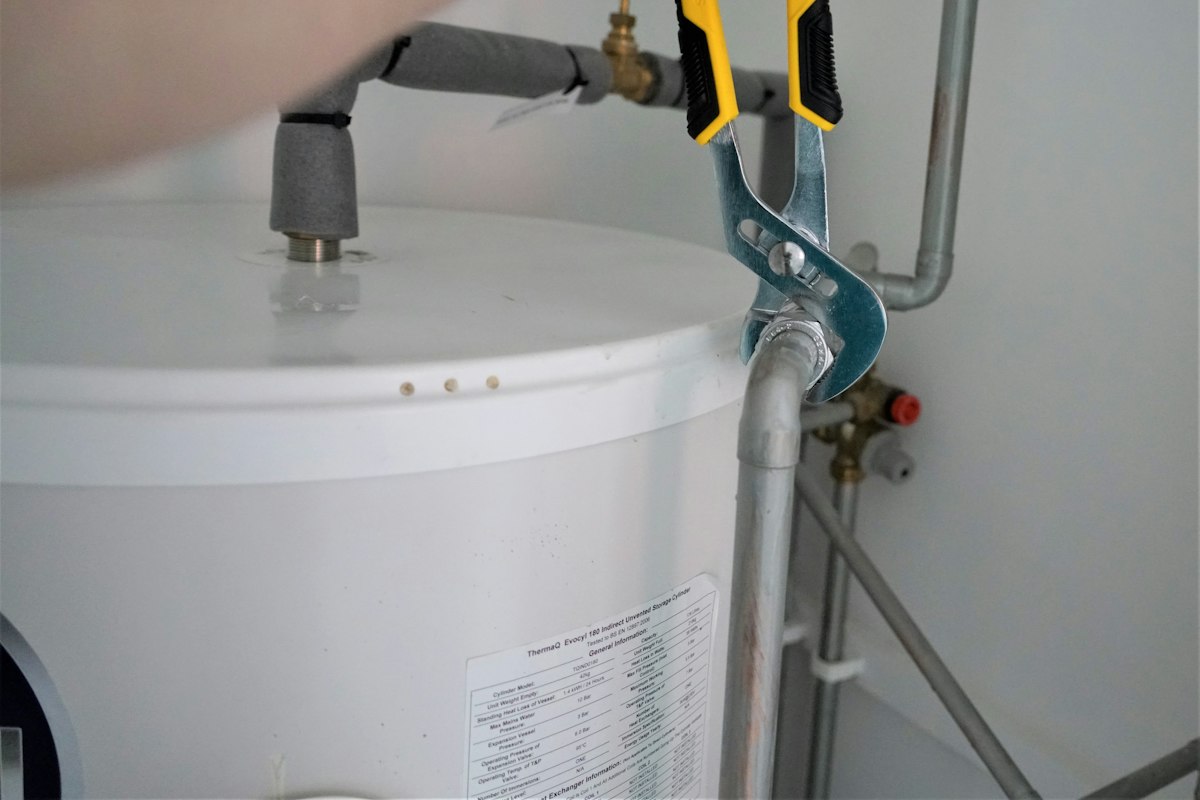
What Is Water Heater Repair and Replacement?
Water heater repair is the diagnosis and fixing of a tank-type water heater that has stopped heating, heats poorly, leaks or makes unusual noises. Water heater replacement is the removal of an old unit and the installation of a new one, sized and connected to meet current codes. A tank water heater is an insulated steel tank, typically holding 30 to 80 gallons, that keeps a supply of water hot and ready, heated either by a gas burner at the bottom or by one or two electric elements inside the tank.
Most tank water heaters last around 8 to 12 years, depending on water quality, maintenance and installation. Inside that lifespan, most faults are a single failed part, such as a thermostat, heating element, thermocouple, gas valve or relief valve, and a repair makes sense. Once the tank itself rusts through and leaks, the only fix is replacement.
This page covers tank water heaters. On-demand units that heat water only when a tap opens are covered on our tankless water heater installation page.
Signs Your Water Heater Needs Attention
Water heaters usually give warning signs before they fail. The eight signs below are the most common.
- No hot water: a gas pilot or burner is out, or an electric element or thermostat has failed.
- Hot water runs out fast: sediment fills the tank, a lower element has failed, or the tank is too small for the household.
- Lukewarm water: a thermostat is set too low or a part is failing.
- Rumbling, popping or banging: sediment on the tank bottom is trapping water that boils and bursts.
- Rusty or discolored hot water: the tank or the anode rod is corroding.
- Rotten-egg smell in hot water: bacteria react with the anode rod, often in well water.
- Water around the base: a leaking fitting, valve or a failing tank.
- Relief valve discharge: the temperature and pressure relief valve is releasing water, a safety warning that needs checking.
Gas vs. Electric Water Heaters
Gas and electric tank heaters store water the same way but heat it differently, so their faults differ. The table below compares them.
| Attribute | Gas tank water heater | Electric tank water heater |
|---|---|---|
| Heat source | Gas burner under the tank | One or two immersion elements |
| Venting | Needs a flue or power vent | No venting |
| Recovery speed | Faster recovery after use | Slower recovery |
| Common failures | Thermocouple, pilot, gas valve, venting | Elements, thermostats, wiring |
| Safety concerns | Combustion air, carbon monoxide, gas leaks | Electrical safety |
| Works in a power outage | Standing-pilot models often do | No |
Switching between gas and electric is possible but involves new gas piping, venting or electrical circuits. Gas work must be done by a qualified professional; see gas line repair.
Common Water Heater Problems and Their Causes
The table below links each symptom to its usual cause and the typical fix.
| Symptom | Likely cause | Typical fix |
|---|---|---|
| No hot water (gas) | Pilot out, failed thermocouple or gas valve | Relight, replace thermocouple or valve |
| No hot water (electric) | Tripped breaker, failed element or thermostat | Reset, replace element or thermostat |
| Not enough hot water | Sediment, failed lower element, broken dip tube, undersized tank | Flush, replace part, or upsize |
| Noisy tank | Sediment buildup | Flush the tank |
| Rusty hot water | Depleted anode rod or corroding tank | Replace anode; replace tank if leaking |
| Smelly hot water | Bacteria reacting with the anode | Replace anode with a suitable type, sanitize |
| Leak at fittings | Loose connection or failed valve | Tighten or replace the fitting or valve |
| Leak from the tank body | Tank corroded through | Replace the water heater |
How a Plumber Repairs a Water Heater
A water heater repair follows five steps. Safety comes first because these appliances combine water, heat and gas or high-voltage power.
- 1
Make it safe: the plumber turns off gas or power and checks for gas leaks, scorching or water near electrical parts.
- 2
Diagnose: the plumber tests the thermostat, elements or burner assembly, checks the relief valve and looks for leaks and corrosion.
- 3
Assess age and condition: the serial number shows the manufacture date, and the tank's condition shows whether a repair is worth it.
- 4
Repair: the failed part is replaced with a matching part, and the tank may be flushed of sediment.
- 5
Test: the plumber restores power or gas, confirms the unit heats to temperature, and checks venting and the relief valve.
Repair or Replace? How to Decide
Most decisions come down to the tank's age and whether the tank itself has failed. The guide below sets out the usual reasoning.
| Situation | Usual recommendation |
|---|---|
| Tank is leaking from the body | Replace: a corroded tank cannot be repaired |
| Unit under about 8 years, one part failed | Repair |
| Unit over about 10 years with a major failure | Replace: further failures are likely |
| Repeated repairs in the past few years | Replace |
| Household has grown and hot water runs out | Replace with a larger tank or consider tankless |
| Unit does not meet current venting or safety codes | Replace or correct as required |
What Happens During Water Heater Replacement
A replacement follows seven steps and usually takes two to four hours for a like-for-like swap.
- 1
Size the new unit: the plumber recommends a tank size and fuel type based on the household's peak hot-water use.
- 2
Shut off and drain: gas or power and water are turned off, and the old tank is drained.
- 3
Disconnect and remove: the old unit is disconnected and taken out of the home.
- 4
Set the new unit: the new heater is placed on a stand or pan as required, with seismic straps where codes call for them.
- 5
Connect: water lines, gas or electrical connections and venting are connected, with an expansion tank where required.
- 6
Fill and start: the tank is filled, air is purged from the lines, and the heater is started and checked for leaks and proper venting.
- 7
Haul away and register: the old unit is removed and the new warranty is registered.
Water Heater Sizes
Tank size is chosen by how many people use hot water at once, not just the number of bedrooms. The table below gives typical starting points for a tank heater. Your plumber refines the choice using your fixtures and habits.
| Household | Typical tank size |
|---|---|
| 1 to 2 people | 30 to 40 gallons |
| 2 to 4 people | 40 to 50 gallons |
| 4 to 5 people | 50 to 60 gallons |
| 5 or more people | 65 to 80 gallons, or tankless |
The first-hour rating on the label shows how much hot water a heater can deliver in an hour of use, and it is a better guide than tank size alone.
What Affects the Cost of Water Heater Service?
The price of water heater repair or replacement depends on the factors below. Your plumber gives you the price before any work begins.
| Factor | Effect on cost |
|---|---|
| Repair vs. replacement | A part replacement costs far less than a new unit |
| Fuel type | Gas units need venting and gas connections |
| Tank size and efficiency | Larger and high-efficiency units cost more |
| Code upgrades | Expansion tanks, straps, pans and venting changes add cost |
| Location | Attic, closet or tight spaces take longer |
| Permits | Many areas require a permit for replacement |
| Timing | Emergency replacements outside business hours may cost more |
Water Heater Safety
Water heaters are safe when installed and maintained correctly. The five safety points below matter most.
- Temperature and pressure relief valve: this valve opens if the tank overheats or over-pressurizes. Never cap or block it.
- Venting: a gas heater must vent combustion gases outside; a blocked vent can cause carbon monoxide buildup.
- Carbon monoxide alarm: homes with gas appliances should have working CO alarms.
- Scald protection: a setting around 120°F reduces scald risk for most households, and anti-scald shower valves add protection; see shower and bathtub repair.
- Clearances: keep flammable items away from a gas heater's burner.
If you smell gas, leave the home and call your gas utility from outside before calling a plumber.
Maintaining a Water Heater
The maintenance tasks below extend a water heater's life.
- Flush the tank yearly: draining a few gallons removes sediment, especially in hard-water areas.
- Test the relief valve: lift the lever briefly once a year to confirm it works.
- Check the anode rod: an anode rod protects the tank from corrosion and is replaced when worn.
- Treat hard water: water softener installation slows sediment and scale buildup.
- Check for leaks: look around the base and fittings a few times a year.
What to Do if Your Water Heater Is Leaking
A leaking water heater can release a lot of water quickly, so act in this order.
- 1
Turn off the power or gas: switch off the breaker for an electric heater, or turn the gas control to "off" or "pilot" on a gas heater.
- 2
Shut off the cold-water supply: close the valve on the cold inlet pipe at the top of the heater.
- 3
Find the source: check whether water is coming from a fitting, the relief valve pipe, the drain valve or the tank itself.
- 4
Contain the water: use towels and a wet vacuum, and move stored items away from the heater.
- 5
Drain the tank if the leak is from the body: attach a hose to the drain valve and run it to a floor drain or outside, taking care because the water is hot.
- 6
Call a plumber: describe where the water is coming from and how old the heater is.
If you cannot find the cold-water valve or it will not close, shut off the main water valve to the house.
Water Heater Efficiency Ratings
Every new water heater carries a Uniform Energy Factor (UEF) rating on its EnergyGuide label. A higher UEF means more of the energy used becomes hot water. The label also shows an estimated yearly operating cost and the first-hour rating, which is how many gallons of hot water the unit can supply in its first hour of use.
Efficiency options for tank heaters include high-efficiency gas models with better insulation and burners, condensing gas models that capture heat from exhaust gases, and heat pump water heaters, which move heat from the surrounding air into the water and use far less electricity than standard electric tanks. Heat pump units need space and air volume around them and work best in warm spaces such as garages in mild climates. Your plumber can explain which options suit your home's space, fuel and budget.
Where a Water Heater Can Be Installed
Location affects safety, cost and how quickly hot water reaches your taps. Codes often require a drain pan with a drain line when a heater sits where a leak could damage the home, such as in an attic, closet or above a finished floor. Gas heaters in garages are often raised so the burner sits above floor level, away from fuel vapors. Earthquake-prone areas require the tank to be strapped to the wall. A heater placed far from the main bathrooms means a longer wait for hot water, which a recirculation system can reduce.
Questions to Ask Your Plumber
- 1
How old is my water heater, and is a repair worth it? The age from the serial number frames the decision.
- 2
What size and fuel type do you recommend, and why? The answer should reflect your household's use.
- 3
What code upgrades are included? Expansion tanks, straps, pans and venting changes should be in the quote.
- 4
Does the price include the permit and haul-away? Confirm before work starts.
- 5
What does the warranty cover? Ask about the tank warranty and the labor warranty separately.
Water Heater FAQs
How long does a water heater last?
A tank water heater usually lasts around 8 to 12 years. Hard water, lack of maintenance and poor installation shorten its life; regular flushing and anode replacement extend it.
Why is my water heater leaking?
A leak at a fitting or valve can usually be repaired. A leak from the tank body means the tank has corroded through and the heater needs replacing.
Is no hot water an emergency?
No hot water is urgent but usually not dangerous. A leaking tank, a gas smell or a relief valve discharging continuously needs prompt attention, which our 24-hour emergency plumbing line handles day or night.
Can I replace a water heater myself?
Replacing a water heater involves gas or high-voltage power, venting, relief valves and permits in many areas. A licensed professional is the safe choice.
Should I switch to a tankless water heater?
A tankless heater gives endless hot water and saves space, but it costs more to install. It suits households that run out of hot water or plan to stay in the home for years.
Related Plumbing Services
Water heaters connect to several other systems. For on-demand hot water, see tankless water heater installation. Gas connections and leaks are handled through gas line repair. Hard water shortens heater life, which water softener installation addresses, and low hot-water flow can be a water pressure repair issue.