The Short Answer
A toilet keeps running because water is leaking from the tank into the bowl, or because the tank never stops filling. The usual causes are a worn flapper, a fill valve set too high, a float that is out of adjustment, a flapper chain that is too short or too long, or a worn flush valve seat. Most of these are inexpensive parts that can be adjusted or replaced in under an hour.
How Does a Toilet Tank Work?
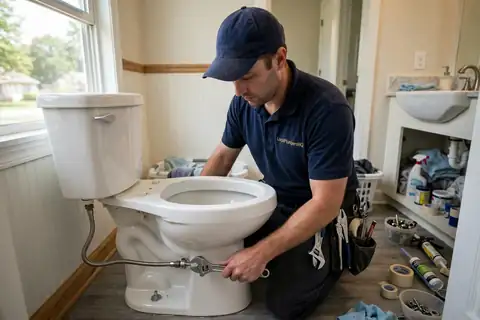
A toilet tank works by holding a measured amount of water and releasing it into the bowl when you press the handle. Pressing the handle pulls a chain that lifts the flapper, a rubber seal at the bottom of the tank. Water rushes through the flush valve into the bowl. When the tank empties, the flapper drops back onto its seat. The fill valve, the tall valve on one side of the tank, then refills the tank until the float rises to the shut-off point. A small refill tube also sends some water down the overflow tube to refill the bowl.
When any one of these parts fails, water either escapes from the tank or the fill valve never shuts off, and the toilet runs.
What Are the Most Common Causes of a Running Toilet?
The six most common causes are listed below, roughly in order of how often plumbers find them.
| Cause | What happens | Typical sign |
|---|---|---|
| Worn or warped flapper | The rubber no longer seals, so water seeps into the bowl | The toilet refills by itself every so often ("phantom flush") |
| Fill valve set too high | The water level rises above the overflow tube and drains away | Water constantly trickles into the overflow tube |
| Float out of adjustment | The float does not rise far enough to shut the valve | The tank fills and keeps hissing |
| Chain too short or too long | A tight chain holds the flapper open; a long one gets trapped under it | Running starts right after a flush |
| Worn flush valve seat | The flapper cannot seal on a rough or cracked seat | A new flapper does not stop the leak |
| Failing fill valve | Worn seals let water through even when the float is up | Hissing or a slow trickle that adjustments do not fix |
How Can I Tell Which Part Is Causing It?
You can find the cause with a few simple checks that take about 20 minutes.
- 1
Take off the tank lid and set it somewhere safe; it is heavy and breaks easily.
- 2
Look at the water level. If water is flowing into the overflow tube, the fill valve or float is set too high.
- 3
Do a dye test. Add a few drops of food coloring to the tank and wait 15 to 20 minutes without flushing. Color in the bowl means the flapper or flush valve seat is leaking.
- 4
Check the chain. With the flapper closed, the chain should have a little slack, about half an inch.
- 5
Listen to the fill valve. A constant hiss with the tank full points to the fill valve.
- 6
Press down on the flapper with a stick while the toilet is running. If the running stops, the flapper is not sealing.
How Do I Fix a Running Toilet Myself?
Most running toilets can be fixed with basic tools and a replacement part from a hardware store. Turn off the water at the valve behind the toilet first and flush to empty the tank.
- Adjust the float: lower the float on the fill valve so the water stops about an inch below the top of the overflow tube.
- Adjust the chain: move the clip so the chain has slight slack when the flapper is closed.
- Replace the flapper: unhook the old flapper from the overflow tube ears and fit a new one of the same size, usually 2 or 3 inches.
- Replace the fill valve: unscrew the nut under the tank, swap the valve, set the height and reconnect the supply line.
- Clean the flush valve seat: wipe away mineral buildup gently so the flapper can seal.
Take the old part to the store to match the size and style, because flappers and fill valves vary between brands.
When Should I Call a Plumber?
Call a plumber when simple fixes do not stop the running, or when the problem goes beyond the tank parts. The situations below are worth a professional visit.
- The flush valve seat is cracked or badly worn and the flush valve must be replaced, which often means removing the tank.
- Water is leaking at the base of the toilet or between the tank and bowl.
- The shut-off valve behind the toilet will not turn or leaks, so the water cannot be stopped safely.
- The toilet is old and parts no longer fit, and a replacement toilet makes more sense.
- You are not comfortable working on the tank or the supply connection.
Our toilet repair page explains what a plumber checks and when a new toilet is the better choice.
Does a Running Toilet Waste a Lot of Water?
Yes. A running toilet wastes water every hour it runs, and a steady leak can add noticeably to a water bill over a month. A silent flapper leak is easy to miss because there is no sound, which is why the dye test is worth doing a couple of times a year. A sudden jump in your water bill is often the first sign; if the toilet is fine, a hidden supply leak may be the cause, as explained in our guide to causes of low water pressure.
How Can I Stop It Happening Again?
You can prevent most running toilets with a little routine care.
- Do the dye test twice a year to catch silent leaks early.
- Avoid in-tank cleaning tablets, which can wear rubber flappers faster.
- Replace the flapper at the first sign of wear; they are inexpensive.
- Keep water pressure in a normal range, since high pressure wears valves faster.
- Turn the shut-off valve off and on once a year so it does not seize.
Related Toilet Problems
A running toilet is one of several common toilet problems. A toilet that clogs often may need clogged drain repair, and a sewer smell in the bathroom can point to a failed wax seal, covered in our guide to why a house smells like sewer.
Running Toilet FAQs
Is a running toilet an emergency?
A running toilet is not usually an emergency. It wastes water but rarely causes damage. It becomes urgent if water is overflowing or leaking onto the floor, in which case turn off the valve behind the toilet.
Why does my toilet run for a few seconds every so often?
A toilet that refills briefly on its own, sometimes called a phantom flush, almost always has a flapper that is leaking slowly into the bowl. Replacing the flapper usually fixes it.
Can I just turn off the water until I fix it?
Yes. Turning the valve behind the toilet clockwise stops the tank refilling. You can still flush once by pouring a bucket of water into the bowl.
How long do toilet flappers last?
Flapper lifespan depends on water quality and cleaning products. Chlorine tablets and hard water shorten it. Replace the flapper whenever the dye test shows a leak.